The 30-second version
- Use an annual vacation bank if you want the simplest policy to explain.
- Use accrual if you need more control over earned balances and payout liability.
- Use unlimited PTO only if your managers will actively encourage people to take time off.
- Every example still needs eligibility, approval, carryover, and payout language.
- For a fuller version, start with the vacation policy template.
Small businesses do not need a 20-page vacation policy. They need a short policy employees can understand before they request time off.
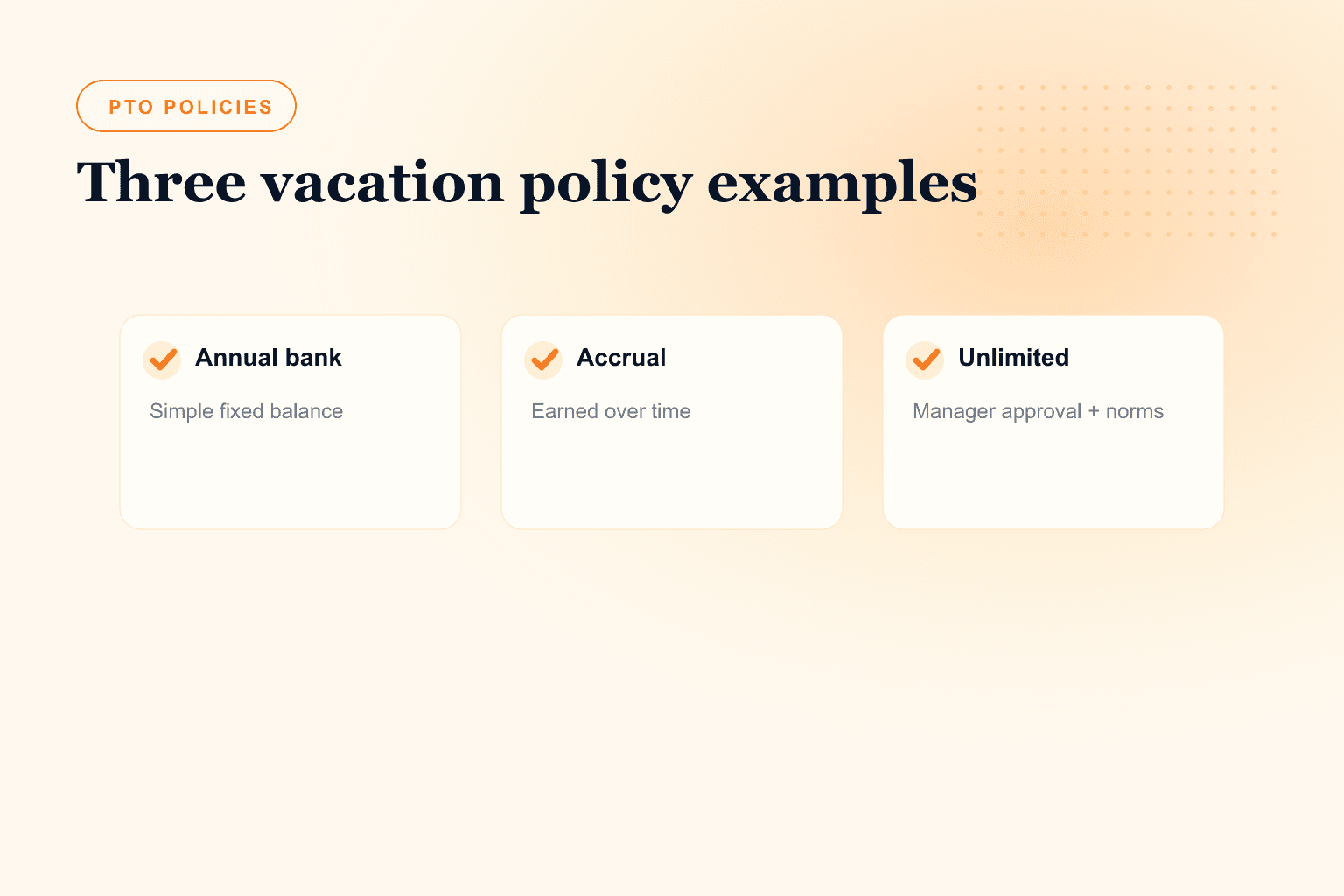
Below are three examples you can adapt: annual bank, accrual, and unlimited vacation. They are written in plain language so they can be copied into a handbook and customized.
Example 1: Annual vacation bank
Best for small teams that want a simple, predictable policy.
Full-time employees receive 15 days of paid vacation each calendar year. New employees become eligible for vacation after 30 days of employment. Employees hired mid-year receive a prorated vacation balance for their first year.
Vacation requests should be submitted at least two weeks in advance. Requests are reviewed by the employee's manager based on team coverage and business needs.
Employees may carry over up to 5 unused vacation days into the following year. Unused days above the carryover cap are forfeited where permitted by law.
This is the easiest model to explain. It works well when your team is small enough that coverage can be managed by managers, but large enough that informal approvals are starting to break down.
Example 2: Accrued vacation policy
Best for teams that want employees to earn vacation over time.
Full-time employees accrue paid vacation at a rate of 1.25 days per month, equal to 15 days per year. Vacation begins accruing on the employee's first day of employment and may be used after 60 days.
Vacation requests should be submitted through the company's time-off system. Managers approve requests based on coverage, project deadlines, and prior approved absences.
Unused accrued vacation may carry over up to a maximum balance of 20 days, unless applicable law requires a different treatment.
Accrual is more precise, but it requires accurate tracking. If you choose this route, avoid manual spreadsheets unless your team is tiny.
Example 3: Unlimited vacation policy
Best for mature salaried teams with high trust and clear performance expectations.
Employees may take paid vacation as needed, subject to manager approval and business coverage. There is no fixed annual vacation bank.
Employees are expected to take meaningful time away from work each year. Managers are responsible for modeling healthy time off and ensuring coverage before approving requests.
Unlimited vacation does not replace legally required sick leave, parental leave, or other protected leave.
Unlimited PTO sounds simple, but it is not self-managing. Without a norm, employees may take less time off than they would under a fixed policy.
What every example still needs
Each vacation policy should answer the same basic questions:
- Who is eligible?
- How much vacation do employees receive?
- When can employees start using it?
- How do they request time off?
- Who approves requests?
- Can unused time carry over?
- What happens when an employee leaves?
For the full checklist, read the complete PTO policy guide for small businesses.
Which example should you choose?
If you are writing your first policy, choose the annual bank. It is simple, readable, and easy for employees to understand.
Choose accrual if you operate in a state where payout liability matters, or if turnover makes front-loading risky. Choose unlimited only if you already have mature managers who can normalize time off.
How Cabana handles this
Copy the policy. Then make it easy to use.
Cabana helps small teams request, approve, and track vacation in Slack, so your written policy does not turn into another spreadsheet chore.
30 days · No credit card
Bottom line
The best vacation policy example is the one your team will actually follow. Keep it short, define the rules, and review it before every new year.