The 30-second version
- This sample PTO policy is designed for small businesses that want a practical starting point.
- Customize the bracketed fields before adding it to a handbook.
- Review state and local requirements before publishing payout, carryover, or sick leave language.
- Pair the policy with a clear approval workflow so it does not become shelfware.
- For broader context, read the complete PTO policy guide.
Use this sample PTO policy as a starting point, not a final legal document. The goal is to give your team clear rules in plain language.
Copyable sample PTO policy
[Company Name] Paid Time Off Policy
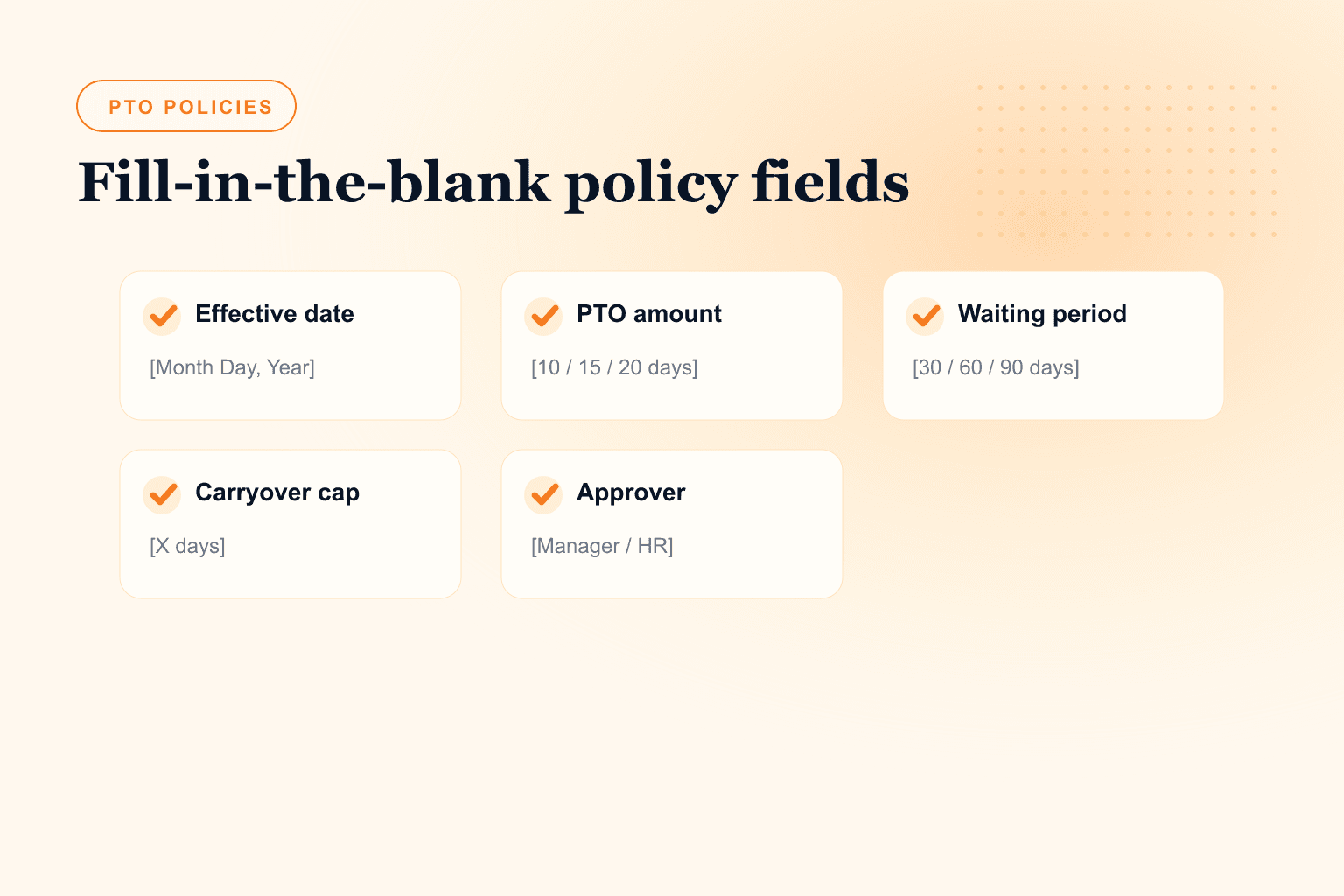
Effective date: [Month Day, Year]
Purpose
[Company Name] provides paid time off so employees can rest, handle personal needs, and take planned time away from work while maintaining business coverage.
Eligibility
Full-time employees are eligible for PTO after [30/60/90] days of employment. Part-time employees working at least [X] hours per week are [eligible for prorated PTO / not eligible for PTO except where required by law].
Annual PTO allowance
Eligible full-time employees receive [10/15/20] days of PTO per calendar year. Employees hired mid-year receive a prorated PTO balance based on their start date.
How PTO is earned
PTO is [granted as a lump sum on January 1 / accrued each pay period / accrued monthly]. Employees may not use more PTO than they have available unless approved in writing by [manager/HR].
Requesting PTO
Employees should submit PTO requests at least [two weeks] in advance when possible. Requests should include the dates requested and any coverage notes needed for the employee's role.
Approval
PTO requests are reviewed by the employee's manager. Approval depends on business needs, team coverage, prior approved absences, and the timing of the request.
Carryover
Employees may carry over up to [X] unused PTO days into the following year. Unused PTO above the carryover cap is forfeited where permitted by applicable law.
Payout when employment ends
Unused PTO is [paid out / not paid out] when employment ends, except where applicable law requires a different result.
Holidays and other leave
Company holidays are separate from PTO. Sick leave, parental leave, bereavement leave, jury duty, and legally protected leave are handled under separate policies where applicable.
Policy questions
Questions about PTO should be directed to [manager/HR contact].
How to customize the sample
Start with the allowance. If you are unsure what to offer, review average PTO for small businesses. Most teams can start with 10 to 15 days, plus holidays.
Then choose the earning method. A lump sum is easier to administer. Accrual is better if you want balances to build over time.
Finally, decide how requests get approved. This should be more specific than "ask your manager." State where requests are submitted and where approved absences are visible.
Common edits for small businesses
If your team is remote, add language about time zones and coverage.
If your business has seasonal busy periods, add blackout dates or extra advance notice requirements.
If you operate in multiple states, confirm payout, carryover, and sick leave rules before publishing the policy.
Where this fits with your vacation policy
Some companies use "vacation policy" and "PTO policy" interchangeably. Others separate vacation, sick time, and personal days. Either approach can work if the document is clear.
If you want a vacation-specific version, use the small business vacation policy examples or the free vacation policy template.
How Cabana handles this
Create a policy without rewriting this by hand.
Cabana's free PTO policy generator turns your choices into a clean policy draft you can copy into your handbook.
30 days · No credit card
Bottom line
A sample policy is useful because it removes the blank page. The real work is choosing the rules you can apply consistently.
Keep the language plain, review the legal pieces, and make the request workflow easy enough that employees actually use it.