The 30-second version
- A written PTO policy replaces case-by-case manager judgment with one set of rules everyone can see.
- There are three structures to choose from: accrual, lump sum, and unlimited. Lump sum is the simplest starting point for most small teams.
- A competitive small-business offer is 15 days plus federal holidays. The legal minimum for paid vacation is zero.
- State law matters: California, Colorado, and Montana ban use-it-or-lose-it vacation policies outright, and several states treat accrued vacation as earned wages.

Someone on your team just asked "so how does PTO work here?" and you don't have a great answer.
Maybe you've been handling it case by case. Maybe there's a policy buried in a Google Doc nobody can find. Maybe the rule is "just ask your manager," which means different people on your team are getting different answers.
This guide fixes that.
Whether you're writing your first paid time off policy or cleaning up one that's outgrown itself, here's everything you need to know: how to structure it, what to include, what to avoid, and how to actually enforce it once it's written.
What is a paid time off policy?
A paid time off policy is the documented set of rules that governs how employees earn, request, and use paid leave, including vacation, sick time, personal days, and sometimes holidays.
It answers the questions your team will ask before they ask them: How many days do I get? When can I use them? Who approves my request? What happens to unused days at year-end?
A PTO policy isn't a legal formality. It's a contract between you and your employees about how time off works. When it's written down, everyone plays by the same rules.
Why your small business needs one in writing
"We're pretty flexible about PTO" sounds great in an interview. But flexibility without a framework creates problems that compound as you grow.
It creates unequal treatment, even when you don't mean it to. Without a written policy, managers make judgment calls. Some are more generous than others. Employees compare notes. Resentment builds.
It creates legal exposure. In many states, accrued PTO is legally considered earned wages. If an employee leaves with 20 unused vacation days and you don't have a clear policy on payout, you may owe them more than you expected, or face a wage claim.
It creates coverage problems. No system for managing overlap means you find out too late that your entire support team is gone the same week.
It slows down your hiring. Candidates want to know what they're signing up for. "We're flexible" is not a benefit. A clear, generous policy is.
A written PTO policy doesn't mean you're becoming a bureaucracy. It means you've decided to treat your team consistently, and that's worth putting in writing.
The three main PTO structures
There's no universally right answer here. The best structure depends on your team size, culture, and how much administrative overhead you want to take on.
1. Accrual-based PTO
Employees earn PTO gradually over time. For example, 1.5 hours for every 40 hours worked adds up to roughly 10 days per year for a full-time employee.
Best for: Businesses that want a sense of fairness tied to tenure, or that want to limit liability if someone leaves early in the year.
Pros: Transparent and easy to explain. Limits large PTO payouts for new hires who leave quickly.
Cons: Requires careful tracking. Unused balances at year-end can become a liability depending on your state's laws.
2. Lump sum (PTO bank)
Employees receive their full annual PTO allotment upfront, either on January 1st or their hire anniversary, and draw from that balance throughout the year.
Best for: Small teams that want simple administration without accrual math.
Pros: Employees can plan ahead and take time off early in the year. Easier to administer than accrual.
Cons: If someone takes their full allotment in Q1 and then resigns, you typically can't recoup that time, depending on your state.
3. Unlimited PTO
Employees can take as much time off as they need, with manager approval, as long as their work is getting done.
Best for: Mature, high-trust teams where output is easy to measure.
Pros: Low administrative overhead. An attractive recruiting perk.
Cons: Research and employee surveys often find that people with unlimited PTO take less time off, not more, because there's no baseline. Without clear expectations, people default to the safest number: zero. This model requires active management encouragement to actually work.
Not sure which structure fits? Check out our free vacation policy template to see how each model looks when written out.
Which PTO structure is right for your team?
| Accrual-basedEarn as you work | Lump sumMost popularAll upfront | UnlimitedTake what you need | |
|---|---|---|---|
| Best for | Fairness tied to tenure | Simple admin, no accrual math | High-trust, output-based teams |
| Admin effort | High | Low | Low |
| Tracking needed | Yes — accruals | Yes — balances | Minimal |
| Year-end risk | Unused balance liability | Forfeiture rules vary by state | Employees often take less time off |
| Sweet spot | 5–100 employees | 5–50 employees | 20+ with strong culture |
What every PTO policy must include
Regardless of which structure you choose, a complete paid time off policy covers these seven elements.
1. How PTO is earned or allocated
Be specific. "Generous PTO" is not a policy. State exactly how many days (or hours) employees receive and when they can access them.
2. Eligibility
When does PTO kick in: day one, after 30 days, after 90 days? Does it differ for full-time vs. part-time employees?
3. How to request time off
Who do employees notify? How far in advance? Is there a blackout period during your busy season? A request process is only useful if everyone knows what it is.
4. The approval process
Who has final say: a direct manager, a central HR contact, or both? What happens when two people on the same small team request the same week?
5. Carryover and expiration rules
Can unused PTO roll over into the next year? Is there a cap? Use-it-or-lose-it policies are common but not legal in every state. More on that below.
6. PTO payout upon separation
If an employee leaves, do they get paid out for unused PTO? In California, for example, this is required by law regardless of what your policy says. In other states, you have more flexibility, but only if your policy clearly addresses it.
7. How PTO interacts with other leave
Does PTO run concurrently with FMLA? What happens during parental leave or short-term disability? This is where small businesses most often get tripped up.
How to build your PTO policy from scratch
A step-by-step process for getting this done, not just thinking about it.
Step 1: Choose your structure. Pick accrual, lump sum, or unlimited. If you're unsure, lump sum is the simplest starting point for most small teams.
Step 2: Decide how much time off. No US state requires employers to offer paid vacation, but 10 to 15 days a year is a common range for small businesses. If you want to be competitive without going unlimited, 15 days plus federal holidays is a strong offer.
Step 3: Define your eligibility rules. When does PTO kick in, and for whom? New hires, part-timers, contractors: be explicit about who's covered.
Step 4: Set your carryover rules. Decide whether unused days roll over, and if so, how many. A cap of 5 to 10 rollover days is common for small teams.
Step 5: Write it in plain language. One page is better than five. If an employee can't understand your policy in five minutes, it needs to be rewritten. Use our vacation policy template as a starting point.
Step 6: Have an employment attorney review it. Especially if you operate in California, Colorado, or any state with complex PTO laws. A one-time review is worth the cost.
Step 7: Add it to your employee handbook and onboarding process. A policy nobody can find is not a policy.
How to roll it out without the eye rolls
Writing the policy is the easy part. Getting your team to actually use it is where things go wrong.
Don't just send a PDF. Email a policy document and watch it get ignored. Walk through it in a team meeting. Even a 10-minute explainer helps people feel informed rather than managed.
Explain the why, not just the what. "We put this in writing so everyone's playing by the same rules" lands very differently than "here are the new rules."
Apply it consistently from day one. Nothing kills a policy faster than managers making exceptions with no explanation. When you do make exceptions, note them.
Make it easy to actually use. If employees have to dig through a handbook to remember how to submit a request, they won't do it. A tool like Cabana puts the entire process (request, approval, balance check) directly in Slack, where your team already is.
The most common PTO policy mistakes
Vague accrual rules. "You earn PTO based on hours worked" tells employees nothing. Give them the actual math.
Ignoring state law. Some states prohibit use-it-or-lose-it policies. Others require payout on separation regardless of what your policy says. Check before you publish.
No blackout period clause. If your business has a busy season, you need a mechanism for managing time-off requests during it, or you'll be scrambling every December.
Applying the policy inconsistently. This is the biggest one. Inconsistent application creates the appearance (and sometimes the reality) of favoritism. It undermines trust and exposes you to claims of discrimination.
Tracking it in a spreadsheet. Spreadsheets break. They go stale. They don't enforce policy rules. Once you have more than five or six employees, manual tracking is a liability.
Never updating the policy. State laws change. Your team grows. Your culture evolves. Review your policy every January and update it when something changes.
State law: what you actually need to know
PTO laws vary significantly by state. Here are the situations where you need to pay close attention.
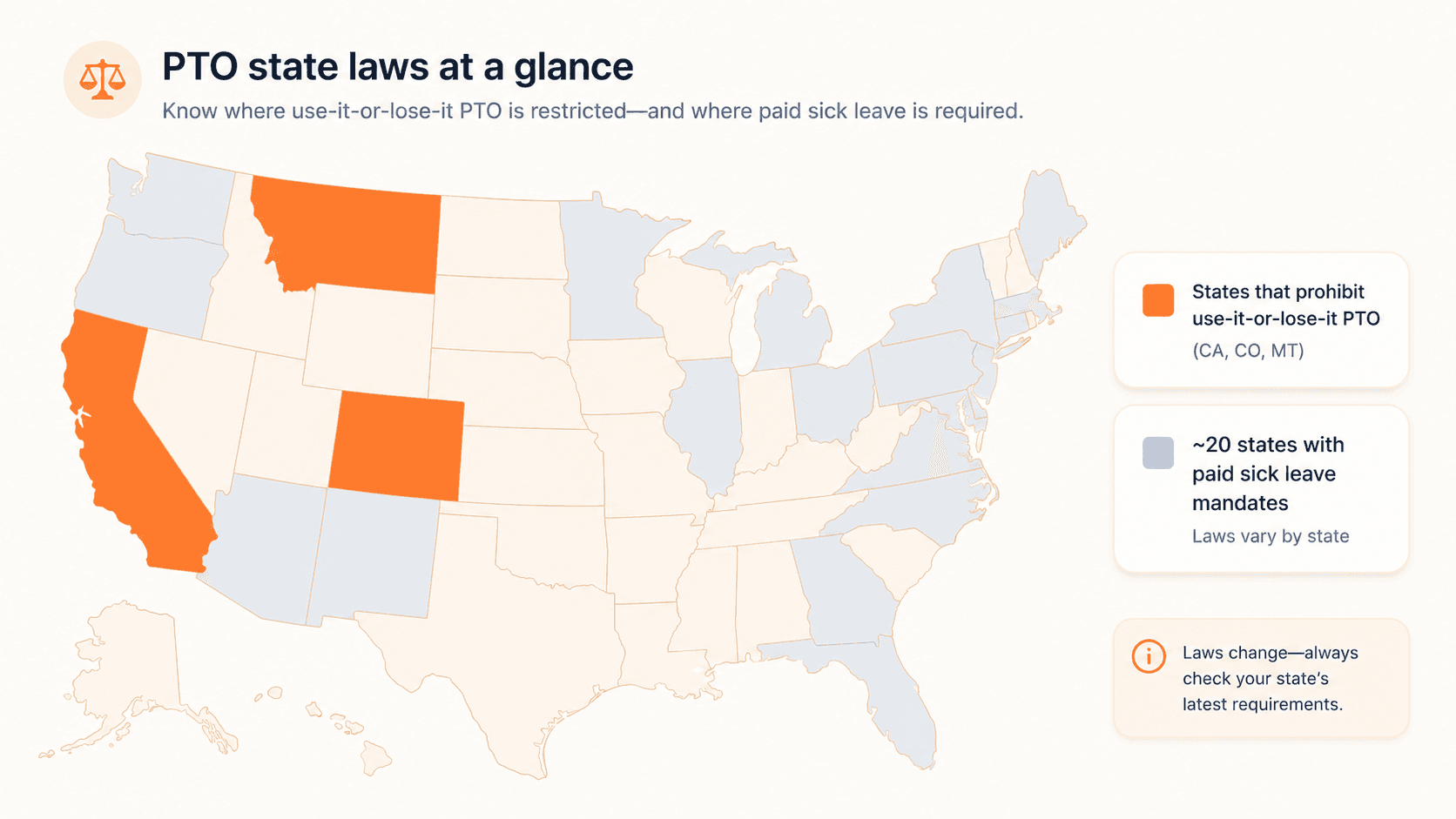
Accrued PTO as earned wages. In California, Colorado, and several other states, accrued vacation time is legally considered earned wages. That means you can't implement a use-it-or-lose-it policy, and you must pay out unused vacation when an employee leaves, even if your policy says otherwise.
Use-it-or-lose-it restrictions. A handful of states, including California, Colorado, and Montana, prohibit use-it-or-lose-it vacation policies outright. Others limit them or allow them only under specific conditions, and most states don't regulate them at all. Because the rules differ so widely, confirm this for every state where you have employees.
Payout on separation. Many states leave this to the employer's discretion, but only if you have a clear written policy. If your policy is silent on the issue, you may be required to pay out regardless.
Sick leave mandates. Around twenty states and many municipalities require employers to provide paid sick leave, each with its own accrual rates and usage rules. This is separate from your general PTO policy in most cases.
This guide is not legal advice. If you're unsure how your state's laws apply to your policy, consult an employment attorney before you publish anything. It's a one-time investment that can prevent significant headaches later.
How to track PTO once the policy is in place
Writing the policy is step one. Actually enforcing it (tracking balances, managing requests, making sure nobody falls through the cracks) is step two.
Most small businesses start with a spreadsheet. It works at three employees and starts breaking down at eight. By fifteen, someone's balance is wrong, an approval got lost, and your HR point of contact is spending hours every month reconciling things manually.
If you're putting a policy in place, or fixing the one you have, it's the right time to set up the infrastructure to actually enforce it.
Channels
Apps
Hey @Cabana, I'd like to request vacation July 14–18 🏖️
New PTO request for James (Manager) to review:
Vacation Request — Sarah Chen
Date range
Jul 14 – Jul 18
Duration
5 days
Leave type
Vacation
Balance after
8 days left
Approved — enjoy the time off, Sarah! 🎉
How Cabana handles this
Skip the spreadsheet
Cabana is Slack-native PTO tracking built for small teams. Employees request time off, managers approve it, and everyone can see who's out, all without leaving Slack.
30 days · No credit card
Related small-business PTO guides
If you are building the policy in pieces, these guides go deeper on the decisions most small teams need to make:
- Average PTO for small businesses for choosing a competitive time-off amount.
- PTO plans for small businesses for choosing between accrual, annual bank, and unlimited PTO.
- Sample PTO policy for small businesses for copyable handbook language.
- Small business vacation policy examples for model policies you can adapt.
- Unpaid time off policy for small business for requests outside paid balances.
Bottom line
A good paid time off policy doesn't need to be long or complicated. It needs to be clear, consistent, and easy to actually use.
When employees know where they stand (how much PTO they have, how to request it, what happens when they don't use it), they spend less mental energy worrying about leave and more energy on the work that actually matters.
Write the policy. Put it somewhere people can find it. Then get a system in place to enforce it without the manual effort. Start for free and your team can be requesting time off the same day.