The 30-second version
- Every vacation policy needs seven things: accrual method, how much time, eligibility, request process, carryover rules, payout on separation, and blackout periods.
- Keep it short — the goal is clarity, not a 20-page legal document.
- Use-it-or-lose-it is illegal in several states without a written cap; check your state laws before finalizing.
- A fill-in-the-blank template is halfway down this page — copy it into your handbook and customize the brackets.
- A policy only works if people can actually track their balances. If that's the weak link, Slack-native tools like Cabana solve it.
Running a small business means juggling a hundred things at once — and writing a formal vacation policy probably isn't at the top of your list. But if you've ever had two employees request the same week off, or watched someone leave and take their unused PTO as a surprise expense, you know why having something in writing matters.
This post gives you a simple vacation policy template you can actually use, plus practical advice on rolling it out without making it feel like a corporate HR exercise.
Why Small Businesses Need a Formal Vacation Policy
It's tempting to just "handle it as it comes up." When you have three employees, that mostly works. But here's what tends to go wrong as you grow:
- Inconsistency. Without a written policy, you make different calls for different people — which creates resentment, even when your intentions are good.
- Surprise liabilities. In many states, accrued PTO counts as earned wages. If someone leaves with 20 unused days, you may owe them a payout. A clear policy prevents nasty surprises.
- Coverage gaps. Without a system for managing overlap, you find out too late that your entire customer success team is out the same week.
- Ambiguity for new hires. People want to know what they're signing up for. A formal policy is part of a professional offer.
A written vacation policy doesn't need to be long or complicated. It just needs to answer the questions your team will actually ask.
What to Include in a Small Business Vacation Policy
A solid vacation policy covers these core elements:
- Accrual method — Do employees earn PTO over time, or get a lump sum at the start of the year?
- How much time off — The actual number of days (or hours) employees receive.
- Eligibility — When does PTO kick in? After 30 days? 90 days? Immediately?
- Request process — How far in advance should employees request time off, and who approves it?
- Carryover rules — Can employees roll unused days into the next year, and if so, how many?
- Payout on separation — Do employees get paid out for unused PTO when they leave?
- Blackout periods — Are there times of year when vacation requests are limited or restricted?
Don't overcomplicate it. The goal is clarity, not a 20-page legal document.
Simple Vacation Policy Template (Fill in the Blanks)
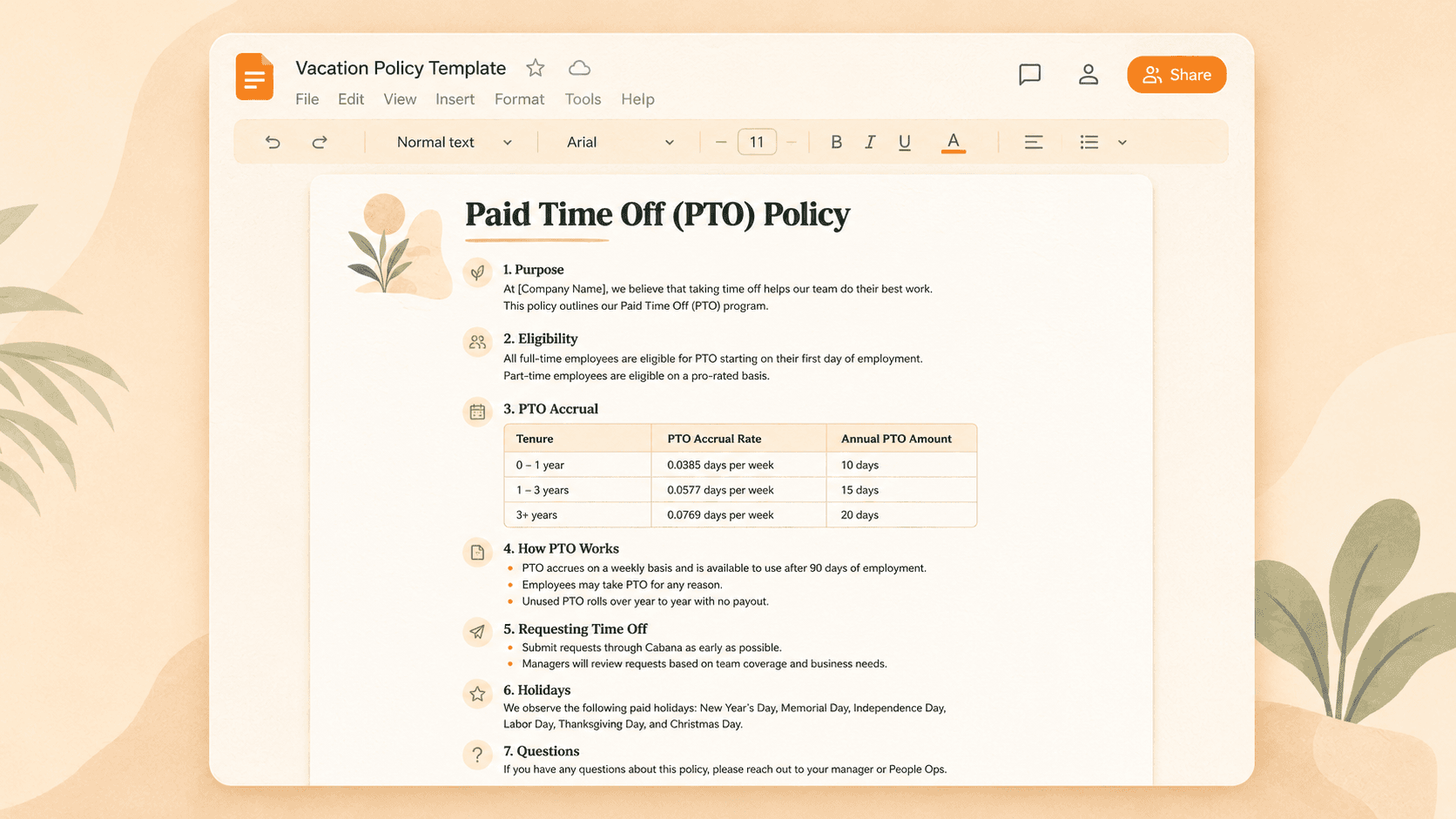
Copy and paste this into your employee handbook, offer letters, or HR system. Customize the bracketed sections for your business.
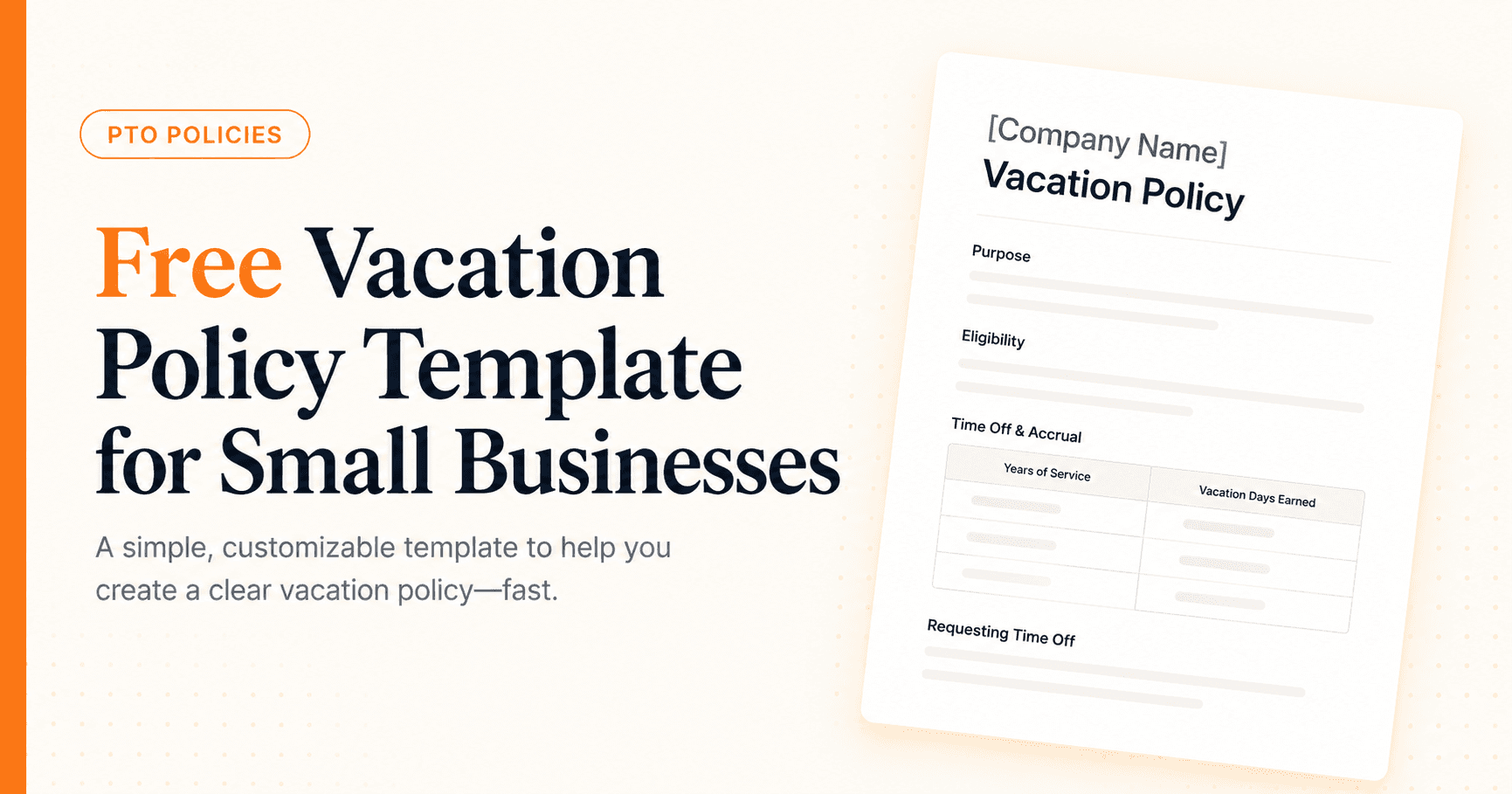
[Company Name] Vacation Policy
Effective Date: [Date]
Eligible Employees: [Full-time employees / Part-time employees working [X]+ hours per week] are eligible for paid vacation under this policy. Vacation benefits begin [immediately upon hire / after [30/60/90] days of employment].
Annual Vacation Allowance:
| Years of Service | Vacation Days Per Year |
|---|---|
| 0–1 year | [10] days |
| 1–3 years | [15] days |
| 3+ years | [20] days |
Vacation time is [accrued at [X] hours per pay period / granted as a lump sum at the start of each calendar year / granted on the employee's anniversary date].
Requesting Time Off:
Employees must submit vacation requests [at least [2 weeks / 30 days] in advance] to their [manager / HR contact]. Requests are subject to approval based on business needs and team coverage. [Company Name] will make reasonable efforts to accommodate requests but cannot guarantee approval during [peak periods / specific blackout dates, e.g., Q4, holiday season].
Carryover:
Employees [may / may not] carry over unused vacation days into the following year. [If carryover is allowed: Employees may carry over a maximum of [X] days. Days above that limit are forfeited at year-end.] [If no carryover: This is a "use it or lose it" policy. Unused vacation days do not roll over and are forfeited at year-end, where permitted by applicable law.]
Payout Upon Separation:
[Upon separation, employees will be paid out for unused accrued vacation days. / Unused vacation days are not paid out upon resignation or termination.]
Note: Payout rules vary by state. Consult your state's labor laws or an employment attorney to confirm what's required in your jurisdiction.
Holidays:
[Company Name] observes [X] paid holidays per year. A current list of company holidays is [available in the employee handbook / shared at the start of each calendar year].
Questions:
Direct questions about this policy to [HR Manager Name / Office Manager Name] at [email address].
This policy is subject to change. Employees will be notified of any updates.
Tips for Rolling Out Your Policy
Once you've written your policy, here's how to make it stick:
1. Share it before it matters. Don't wait until someone asks for time off to explain the rules. Include the policy in your onboarding packet and employee handbook.
2. Walk through it verbally. A quick 10-minute team meeting goes a long way. People follow rules they've heard explained more readily than ones they skimmed in a PDF.
3. Apply it consistently. This is the most important one. Make exceptions without documenting why and you'll undermine the whole policy. When you do make exceptions, note them.
4. Revisit it annually. As your team grows and your business changes, your policy may need to evolve. Set a reminder to review it each January.
5. Make it easy to track. A policy only works if people know how many days they've used and how many they have left. If your team regularly asks "how many vacation days do I have?" — your tracking system needs work.
How Cabana handles this
Your vacation policy, enforced automatically.
Cabana is Slack-native PTO tracking for small businesses. Your team requests time off, managers approve it, and balances update automatically — all inside Slack. No spreadsheets, no extra logins, no 'did you approve that?' threads.
30 days · No credit card
Track Your Policy Without the Spreadsheet Chaos
Writing the policy is step one. Managing it day-to-day is step two — and that's where things tend to fall apart for small teams. Manually tracking PTO in spreadsheets, or relying on people to remember their own balances, creates errors and awkward conversations.
That's exactly what Cabana is built for. It's a Slack-native PTO tracker for small businesses — your team can request time off, get approvals, and check balances directly in Slack, without a new HR platform or another spreadsheet to maintain.
Give it a try — your future self will thank you.