
PTO Payout Calculator
Work out what unused PTO is worth at separation — and whether your state requires you to pay it at all.
Gross payout value
$2,400.00
80 hours (10 days) at $30.00/hour
Is it legally owed?
Select a state
Payout obligations are set by state law and by what your policy promises. Pick a state to see which rule applies.
Worth knowing
- This is a gross figure. PTO payout is treated as supplemental wages, so income tax withholding, FICA, and any state or local taxes come out of it.
Balances you can actually trust at separation
The hard part isn't the multiplication — it's knowing the balance was right in the first place. Cabana tracks accruals, usage, and adjustments with an audit trail, so the final number isn't a spreadsheet guess.
PTO payout laws by state
Whether unused PTO has to be paid out at separation, and whether you can run a use-it-or-lose-it policy, in all 50 states and DC. Every row links to the state labor agency so you can check the primary source.
Showing 51 of 51. Last reviewed August 2026.
| State | Payout required at separation? | Use-it-or-lose-it? | What it means | Source |
|---|---|---|---|---|
| AlabamaAL | Only if your policy says so | Permitted | No state law requires vacation payout. Whatever your written policy says controls, so say it clearly. | Alabama Department of Labor ↗ |
| AlaskaAK | Only if your policy says so | Permitted | Payout is governed by your policy. Alaska wage law enforces what you promised in writing.Also has a statewide paid sick leave mandate. | Alaska Department of Labor and Workforce Development ↗ |
| ArizonaAZ | Only if your policy says so | Permitted | Vacation payout follows your policy. Arizona separately mandates accrued paid sick time, which has its own carryover rules.Also has a statewide paid sick leave mandate. | Industrial Commission of Arizona ↗ |
| ArkansasAR | Only if your policy says so | Permitted | No statutory payout requirement. Your written policy governs. | Arkansas Department of Labor and Licensing ↗ |
| CaliforniaCA | Required by law | Not permitted | Accrued vacation is earned wages. It never expires and must be paid out in full at separation, whatever your policy says.Also has a statewide paid sick leave mandate. | California Department of Industrial Relations ↗ |
| ColoradoCO | Required by law | Not permitted | Earned vacation is wages under the Colorado Wage Act. Forfeiture provisions are unenforceable and unused time must be paid out.Also has a statewide paid sick leave mandate. | Colorado Department of Labor and Employment ↗ |
| ConnecticutCT | Only if your policy says so | Permitted with advance written notice | Payout follows your written policy, and Connecticut enforces it as wages. Forfeiture needs to be spelled out in advance.Also has a statewide paid sick leave mandate. | Connecticut Department of Labor ↗ |
| DelawareDE | Only if your policy says so | Permitted | Your policy controls payout. Put the rule in writing before anyone leaves. | Delaware Department of Labor ↗ |
| District of ColumbiaDC | Only if your policy says so | Permitted with advance written notice | Accrued leave promised by policy is treated as wages at separation. DC also mandates paid sick leave separately.Also has a statewide paid sick leave mandate. | DC Department of Employment Services ↗ |
| FloridaFL | Only if your policy says so | Permitted | No state law on vacation payout at all. Your written policy is the only thing that governs. | Florida Department of Commerce ↗ |
| GeorgiaGA | Only if your policy says so | Permitted | No statutory payout requirement. Policy governs. | Georgia Department of Labor ↗ |
| HawaiiHI | Only if your policy says so | Permitted | Payout is a matter of policy and contract, enforced under Hawaii wage law. | Hawaii Department of Labor and Industrial Relations ↗ |
| IdahoID | Only if your policy says so | Permitted | Your written policy determines whether unused time is paid out. | Idaho Department of Labor ↗ |
| IllinoisIL | Required by law | Permitted with advance written notice
| Earned vacation must be paid out at separation. A use-it-or-lose-it policy is allowed only if employees get a reasonable opportunity to take the time first.Also has a statewide paid sick leave mandate. | Illinois DOL — vacation FAQ ↗ |
| IndianaIN | Required unless your policy says otherwise | Permitted with advance written notice | Accrued vacation is deferred compensation payable at separation — but a clear written policy or agreement setting conditions on payment controls.
| Indiana DOL — accrued vacation FAQ ↗ |
| IowaIA | Only if your policy says so | Permitted | Vacation counts as wages under Iowa's Wage Payment Collection Law when your policy provides it. | Iowa Division of Labor ↗ |
| KansasKS | Only if your policy says so | Permitted | Payout follows your written policy or employment agreement. | Kansas Department of Labor ↗ |
| KentuckyKY | Only if your policy says so | Permitted | Your policy governs, and Kentucky wage law will enforce what it says. | Kentucky Labor Cabinet ↗ |
| LouisianaLA | Required by law | Not permitted | Accrued vacation is wages under La. R.S. 23:631 and must be paid at separation. Forfeiture clauses are unenforceable. | Louisiana Workforce Commission ↗ |
| MaineME | Required by law | Permitted with advance written notice | Private employers with 11 or more employees must pay out unused vacation at separation under 26 M.R.S. § 626.
| 26 M.R.S. § 626 ↗ |
| MarylandMD | Required unless your policy says otherwise | Permitted with advance written notice | Unused leave must be paid out unless a written policy given to the employee at hire says otherwise.Also has a statewide paid sick leave mandate. | Maryland Department of Labor ↗ |
| MassachusettsMA | Required by law | Permitted with advance written notice
| Vacation pay is wages and must be paid out at separation. A forfeiture policy is permitted only with clear advance notice and a real chance to use the time.Also has a statewide paid sick leave mandate. | Mass. AG — vacation policy advisory ↗ |
| MichiganMI | Only if your policy says so | Permitted with advance written notice | Fringe benefits including vacation are payable per your written policy under Michigan's wage payment act.Also has a statewide paid sick leave mandate. | Michigan Department of Labor and Economic Opportunity ↗ |
| MinnesotaMN | Only if your policy says so | Permitted | Vacation payout is governed by your policy or contract. Minnesota separately mandates earned sick and safe time.Also has a statewide paid sick leave mandate. | Minnesota Department of Labor and Industry ↗ |
| MississippiMS | Only if your policy says so | Permitted | No state law on vacation payout. Your policy is the whole rulebook. | Mississippi Department of Employment Security ↗ |
| MissouriMO | Only if your policy says so | Permitted | Payout follows your written policy. The statewide paid sick leave requirement ended on 28 August 2025. | Missouri DOL — paid sick time repeal ↗ |
| MontanaMT | Required by law | Not permitted | Accrued vacation is wages once the probationary period ends, and must be paid out at separation. | Montana Department of Labor and Industry ↗ |
| NebraskaNE | Required by law | Not permitted | The Nebraska Wage Payment and Collection Act treats earned vacation as wages that must be paid at separation.Also has a statewide paid sick leave mandate. | Nebraska Department of Labor ↗ |
| NevadaNV | Only if your policy says so | Permitted | Vacation payout depends on your policy. Nevada separately requires most employers to provide paid leave usable for any reason.Also has a statewide paid sick leave mandate. | Nevada Office of the Labor Commissioner ↗ |
| New HampshireNH | Only if your policy says so | Permitted with advance written notice | Vacation is payable at separation where your written policy or practice provides for it. | New Hampshire Department of Labor ↗ |
| New JerseyNJ | Only if your policy says so | Permitted | Payout follows your policy. New Jersey separately mandates earned sick leave for nearly all employees.Also has a statewide paid sick leave mandate. | New Jersey Department of Labor and Workforce Development ↗ |
| New MexicoNM | Only if your policy says so | Permitted | Your policy governs vacation payout. New Mexico separately requires earned paid sick leave.Also has a statewide paid sick leave mandate. | New Mexico Department of Workforce Solutions ↗ |
| New YorkNY | Only if your policy says so | Permitted with advance written notice | No payout requirement unless your policy promises one — but forfeiture only holds if you told employees in writing beforehand.Also has a statewide paid sick leave mandate. | New York State Department of Labor ↗ |
| North CarolinaNC | Required unless your policy says otherwise | Permitted with advance written notice | Accrued vacation must be paid out unless a written policy forfeiting it was communicated to the employee in advance. | North Carolina Department of Labor ↗ |
| North DakotaND | Required by law | Permitted with advance written notice
| Accrued vacation must be paid out, with a narrow first-year exception. A forfeiture policy is allowed only with advance written notice.
| North Dakota DOL — wage and hour FAQ ↗ |
| OhioOH | Only if your policy says so | Permitted | Vacation payout is a contract question, decided by your written policy. | Ohio Department of Commerce ↗ |
| OklahomaOK | Only if your policy says so | Permitted | Vacation is wages under Oklahoma law when your policy provides for it, and is payable at separation on those terms. | Oklahoma Department of Labor ↗ |
| OregonOR | Only if your policy says so | Permitted | Payout follows your policy. Oregon separately requires paid sick time, which a combined PTO bank must satisfy.Also has a statewide paid sick leave mandate. | Oregon Bureau of Labor and Industries ↗ |
| PennsylvaniaPA | Only if your policy says so | Permitted | Vacation is a fringe benefit payable per your written policy under the Wage Payment and Collection Law. | Pennsylvania Department of Labor and Industry ↗ |
| Rhode IslandRI | Required by law | Permitted with advance written notice | Where a policy or agreement provides vacation, employees with at least one year of service must be paid accrued vacation at separation.
| R.I. Gen. Laws § 28-14-4 ↗ |
| South CarolinaSC | Only if your policy says so | Permitted with advance written notice | Payout follows your policy, and South Carolina requires you to notify employees of that policy in writing. | South Carolina Department of Labor, Licensing and Regulation ↗ |
| South DakotaSD | Only if your policy says so | Permitted | No statutory payout requirement. Your written policy governs. | South Dakota Department of Labor and Regulation ↗ |
| TennesseeTN | Only if your policy says so | Permitted | Payout is determined by your written policy or employment agreement. | Tennessee Department of Labor and Workforce Development ↗ |
| TexasTX | Only if your policy says so | Permitted | No state law requires vacation payout. The Texas Payday Law enforces whatever your written policy promises. | Texas Workforce Commission ↗ |
| UtahUT | Only if your policy says so | Permitted | Your policy governs whether unused vacation is paid at separation. | Utah Labor Commission ↗ |
| VermontVT | Only if your policy says so | Permitted | Payout follows your policy. Vermont separately requires earned sick time for most employees.Also has a statewide paid sick leave mandate. | Vermont Department of Labor ↗ |
| VirginiaVA | Only if your policy says so | Permitted | No statutory payout requirement. Your written policy controls. | Virginia Department of Labor and Industry ↗ |
| WashingtonWA | Only if your policy says so | Permitted | Vacation payout follows your policy. Washington separately mandates paid sick leave that a PTO bank must satisfy.Also has a statewide paid sick leave mandate. | Washington State Department of Labor and Industries ↗ |
| West VirginiaWV | Only if your policy says so | Permitted with advance written notice | Vacation is a fringe benefit that counts as wages only on the terms your written policy sets — the policy decides whether anything becomes payable. | WV Division of Labor — wage payment fact sheet ↗ |
| WisconsinWI | Only if your policy says so | Permitted | Wisconsin enforces vacation payout as wages where your policy or agreement provides for it. | Wisconsin Department of Workforce Development ↗ |
| WyomingWY | Only if your policy says so | Permitted with advance written notice | Vacation is payable per your written policy, and forfeiture must be disclosed to employees in advance. | Wyoming Department of Workforce Services ↗ |
Last checked August 2026. This table is general guidance rather than legal advice. State rules change, and some of these positions come from case law as well as statute, so each row links to the state's own source — worth confirming there, or with an employment attorney, before you rely on it.
The two questions that decide a PTO payout
There's no federal law requiring paid vacation, let alone requiring you to cash it out. So the answer always comes from two places, in this order:
Does your state treat accrued vacation as earned wages? In California, Colorado, Illinois, Louisiana, Massachusetts, Montana, and Nebraska, time an employee has already earned belongs to them and a company policy saying otherwise doesn't change it. Three more require payout but attach conditions worth checking: Maine applies only to private employers with 11 or more employees, Rhode Island only after a year of service, and North Dakota carves out a narrow first-year exception. Indiana, Maryland, and North Carolina sit in between — payout is the default, but a clear written policy given in advance can disclaim it.
What does your written policy say? In the remaining states, the obligation comes from your own document. That cuts both ways: promise a payout and state wage-payment law will enforce it; say clearly that you don't pay out and that's generally enforceable too. The dangerous option is silence, because ambiguity in an employment policy is usually read in the employee's favour.
Use-it-or-lose-it, and the safer alternative
A use-it-or-lose-it policy forfeits time an employee already earned, which is why California, Colorado, Louisiana, Montana, and Nebraska won't enforce one at all. Most other states will, but only where the policy was written down, given in advance, and left a realistic chance to use the time — and in Illinois and Massachusetts, anything still accrued at separation must be paid out regardless. An accrual ceiling gets you the same balance-sheet outcome legally: employees simply stop accruing once they hit a limit, so nothing earned is ever taken away. If you operate in California or Colorado, that's the design you want — the accrual calculator models both.
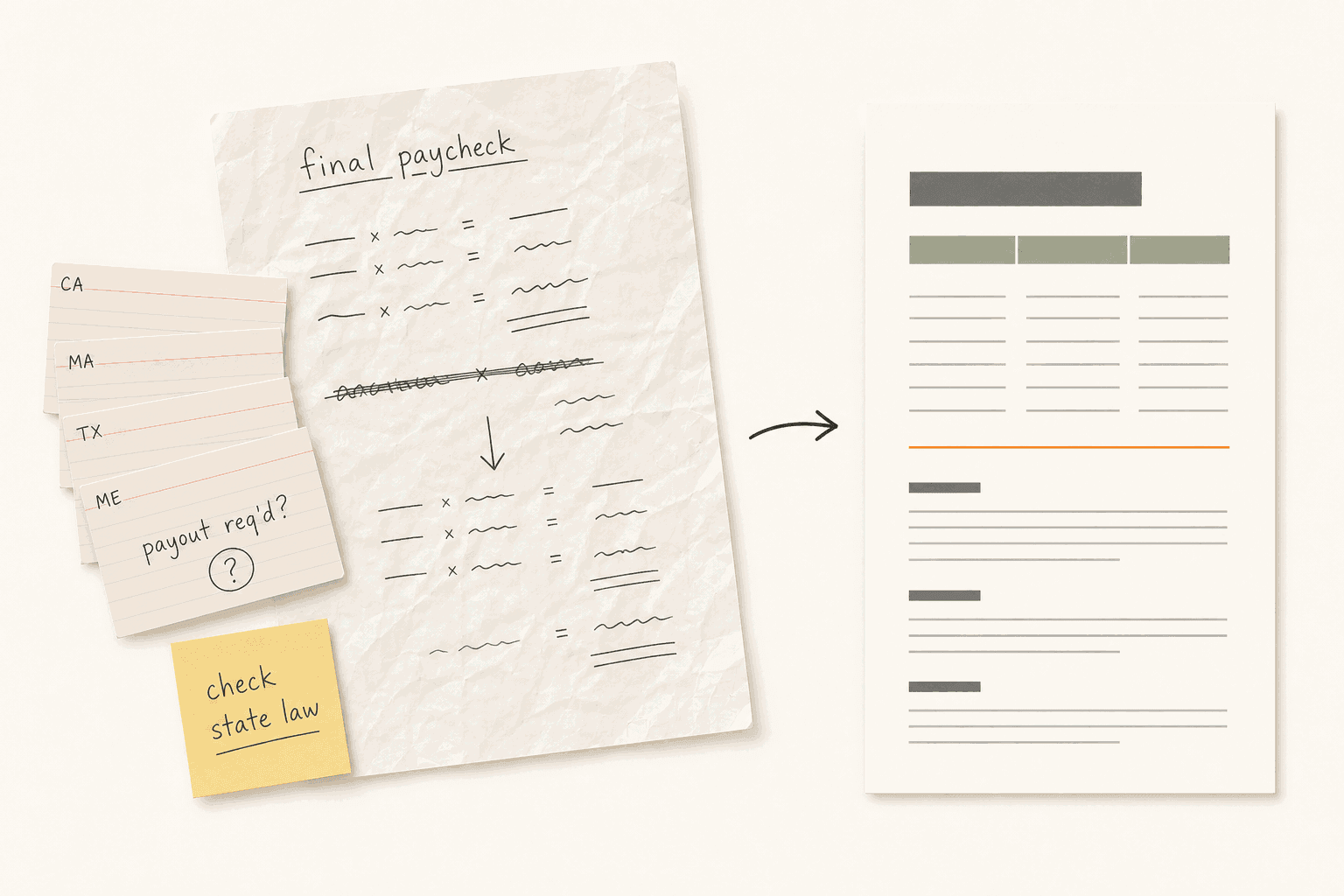
Getting the number right
- Use the final regular rate. Not the rate in effect when the time was accrued. If someone got a raise, the payout follows the raise.
- This figure is gross. PTO payout is a supplemental wage, so withholding and FICA come out. We deliberately don't estimate net — it depends on the employee and their state, and a confident wrong number is worse than none.
- Check final-paycheck deadlines. Several states require the final cheque within a set number of days, sometimes immediately on involuntary termination. The payout has to land inside that window.
- Unlimited PTO usually has no payout, because nothing accrues. That only holds if the policy is genuinely unlimited in practice.
Last checked August 2026. This is general guidance rather than legal advice, and employment rules do change. Worth a quick check with your state labor agency or an employment attorney before relying on anything state-specific.
Frequently asked questions
How do you calculate a PTO payout?
Multiply the unused hours by the employee's regular hourly rate. For a salaried employee, divide the annual salary by the annual working hours — 2,080 for a standard full-time schedule — to get that rate. Ten unused days at eight hours a day for someone earning $30/hour is 80 × $30 = $2,400 gross.
Is an employer legally required to pay out unused PTO?
There is no federal requirement. It comes down to your state and your policy. Seven states treat accrued vacation as earned wages that must be paid out no matter what the policy says, and three more require it subject to conditions like employer size or length of service. A few others default to payout unless your written policy disclaims it in advance. In the rest, the obligation comes from your own policy — which state wage-payment law then enforces. The table on this page breaks it down state by state.
Which states require PTO payout on termination?
California, Colorado, Illinois, Louisiana, Massachusetts, Montana, and Nebraska treat accrued vacation as wages payable at separation, and a company policy cannot disclaim it. Three more require payout subject to statutory conditions: Maine (private employers with 11 or more employees), Rhode Island (employees with at least a year of service), and North Dakota (with a narrow first-year exception). Indiana, Maryland, and North Carolina default to payout unless a clear written policy given to the employee in advance says otherwise. Everywhere else, your own policy creates the obligation.
Is use-it-or-lose-it legal?
It depends on the state. California, Colorado, Louisiana, Montana, and Nebraska don't allow forfeiture of time an employee already earned. Most other states permit it where the policy is in writing, was communicated in advance, and left the employee a realistic chance to take the time — Illinois and Massachusetts are explicit about that last condition, and both still require payout of whatever remains at separation. In every state, an accrual ceiling, where employees simply stop accruing at a limit, is the safer way to control balances.
Is PTO payout taxed differently?
It's taxed as supplemental wages, so income tax withholding may be applied at a flat supplemental rate rather than your normal withholding, and FICA still applies. The figure this calculator produces is gross — the net will be lower, and by how much depends on the employee and their state.
Does the payout rate change if someone got a raise?
Generally you pay out at the employee's final regular rate, not the rate in effect when the time was accrued. A handful of states and many policies say this explicitly. If your policy is silent, paying at the final rate is the safer reading.
Do these rules apply to unlimited PTO?
Usually not, because nothing accrues — there's no balance to pay out. That's a large part of why unlimited PTO is attractive to employers in states like California. But if your unlimited policy is administered in a way that effectively creates accrued time, courts have looked past the label, so it needs to be genuinely unlimited.
Is this calculator free?
Yes. No sign-up, no email, and nothing leaves your browser.
Other free tools


Related reading
Tools that track balances for you
If your payout figure comes from a spreadsheet, this is the upgrade path.
Deeper policies, a real admin dashboard, and stronger Teams support.
Microsoft Teams support and department structure alongside the same Slack workflow.
Easier day-to-day PTO workflow alongside the payroll tool you already use.
All the leave management, none of the HR platform overhead.
PTO without the timesheet and attendance features your team doesn't need.
Purpose-built for PTO, not buried inside a full HR platform.