The 30-second version
- The three common small-business PTO examples are annual bank, accrual, and unlimited.
- Annual bank is simplest; accrual is more controlled; unlimited requires strong management norms.
- Good examples include request, approval, carryover, and payout language.
- Avoid copying any example without adapting it to your state and team structure.
- Start with the pillar guide: PTO policy for small businesses.
Good PTO policy examples are useful because they show how the pieces fit together.
The exact numbers will change by company, but the structure should stay consistent: eligibility, amount, earning method, request process, approval rules, carryover, and payout.
Example 1: Simple annual PTO bank
Full-time employees receive 15 days of PTO per calendar year. New hires receive a prorated balance based on their start date. PTO may be used for vacation, personal time, or illness unless a separate sick leave policy applies.
Requests should be submitted at least two weeks in advance when possible. Managers approve requests based on business needs and team coverage.
Employees may carry over up to 5 unused days into the next calendar year, where permitted by law.
This is the best starting example for many small businesses. It is easy to explain and does not require monthly accrual math.
Example 2: Accrued PTO
Full-time employees accrue PTO each pay period up to an annual total of 15 days. PTO begins accruing on the first day of employment and may be used after 60 days.
Employees may not use PTO before it is accrued unless approved in writing. Unused accrued PTO may carry over up to a maximum balance of 20 days.
Upon separation, unused accrued PTO is handled according to company policy and applicable law.
This example is better when you want more control over earned balances. It needs accurate tracking, especially if employees are hourly or paid biweekly.
Example 3: Unlimited PTO
Employees may take PTO as needed, subject to manager approval, business needs, and team coverage. There is no fixed annual PTO bank.
Employees are expected to plan absences responsibly, communicate coverage needs, and take meaningful time away from work each year.
Unlimited PTO does not replace legally required sick leave or other protected leave.
Unlimited PTO can be attractive, but it is not a shortcut around management. It needs written expectations so employees know what "reasonable" means.
What these examples have in common
Each example answers the same operating questions:
- How much time off is available?
- When does it become available?
- How does an employee request it?
- Who approves it?
- What happens to unused time?
- What happens when employment ends?
If your draft does not answer those questions, it is not complete yet.
Choosing the example that fits
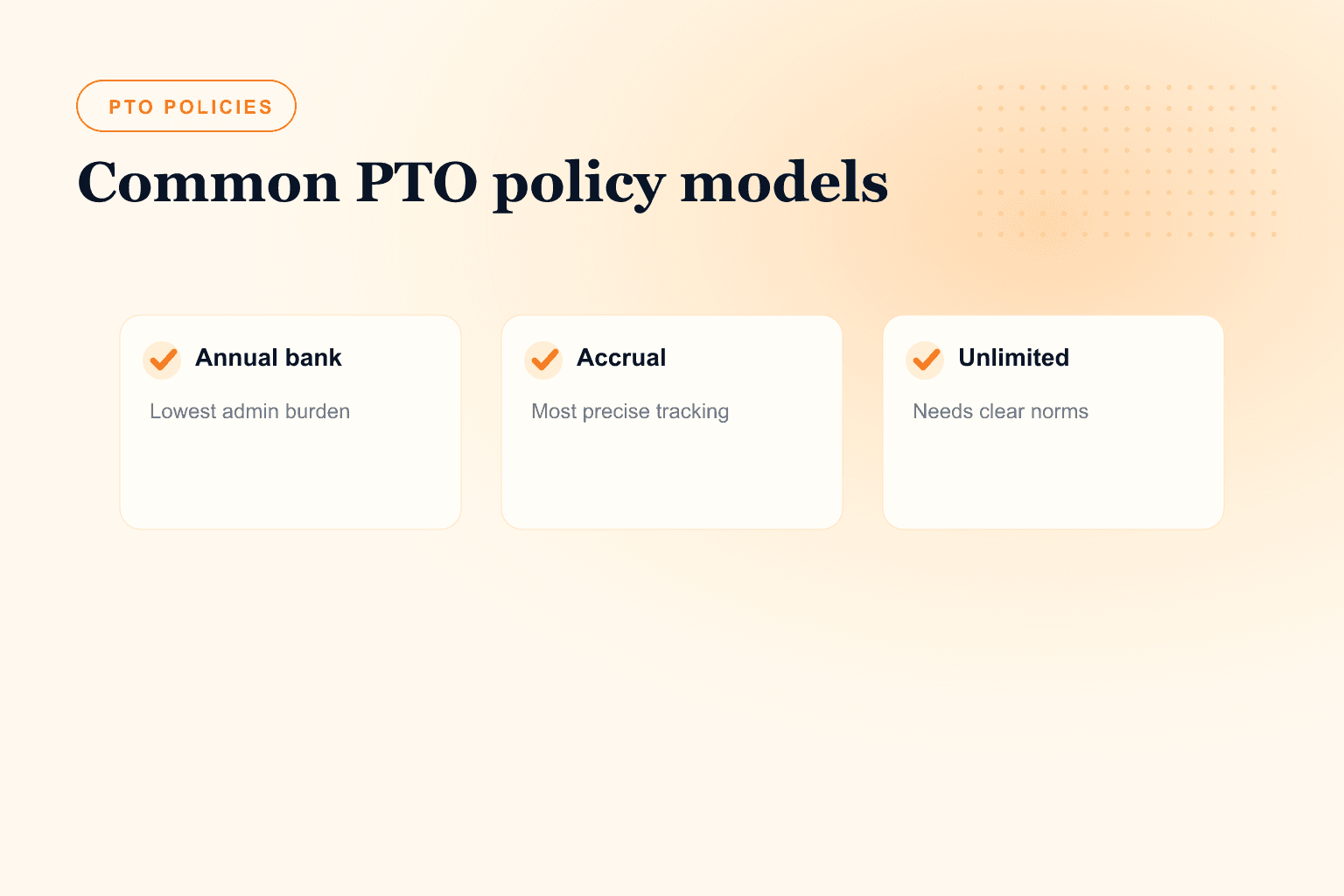
Choose the annual bank if you want the lowest admin burden. Choose accrual if you need balance precision. Choose unlimited if your team already has strong trust, clear goals, and managers who take vacation themselves.
If you want a fill-in-the-blank version, use the sample PTO policy for small businesses or the vacation policy template.
How Cabana handles this
Use the example, then automate the workflow.
Cabana helps small teams enforce PTO policies in Slack with requests, approvals, balances, and a shared calendar.
30 days · No credit card
Bottom line
The best PTO policy example is specific enough to enforce and simple enough to remember. Pick the model that fits your team, adjust the details, and keep the workflow visible.