The 30-second version
- A solid small-business PTO benchmark is 10 to 15 days per year, plus paid holidays.
- If you hire for competitive tech, operations, or professional services roles, 15 to 20 days is a stronger offer.
- Separate sick leave is often easier to explain and safer to administer than one all-purpose bucket.
- The best PTO number is one your business can cover consistently, not the most generous number you can put in a handbook.
- Once you pick the number, write it into a clear PTO policy for small business and track it somewhere reliable.
The hardest part of writing a PTO policy is not the wording. It is deciding what feels fair.
Offer too little and candidates notice. Offer too much without a request process and your managers end up negotiating every absence by hand. For most small businesses, the right answer is a simple middle ground: enough time off to feel credible, paired with rules your team can actually administer.
A reasonable small-business PTO benchmark
For full-time employees, a practical baseline is:
| Team stage | Common PTO offer | Notes |
|---|---|---|
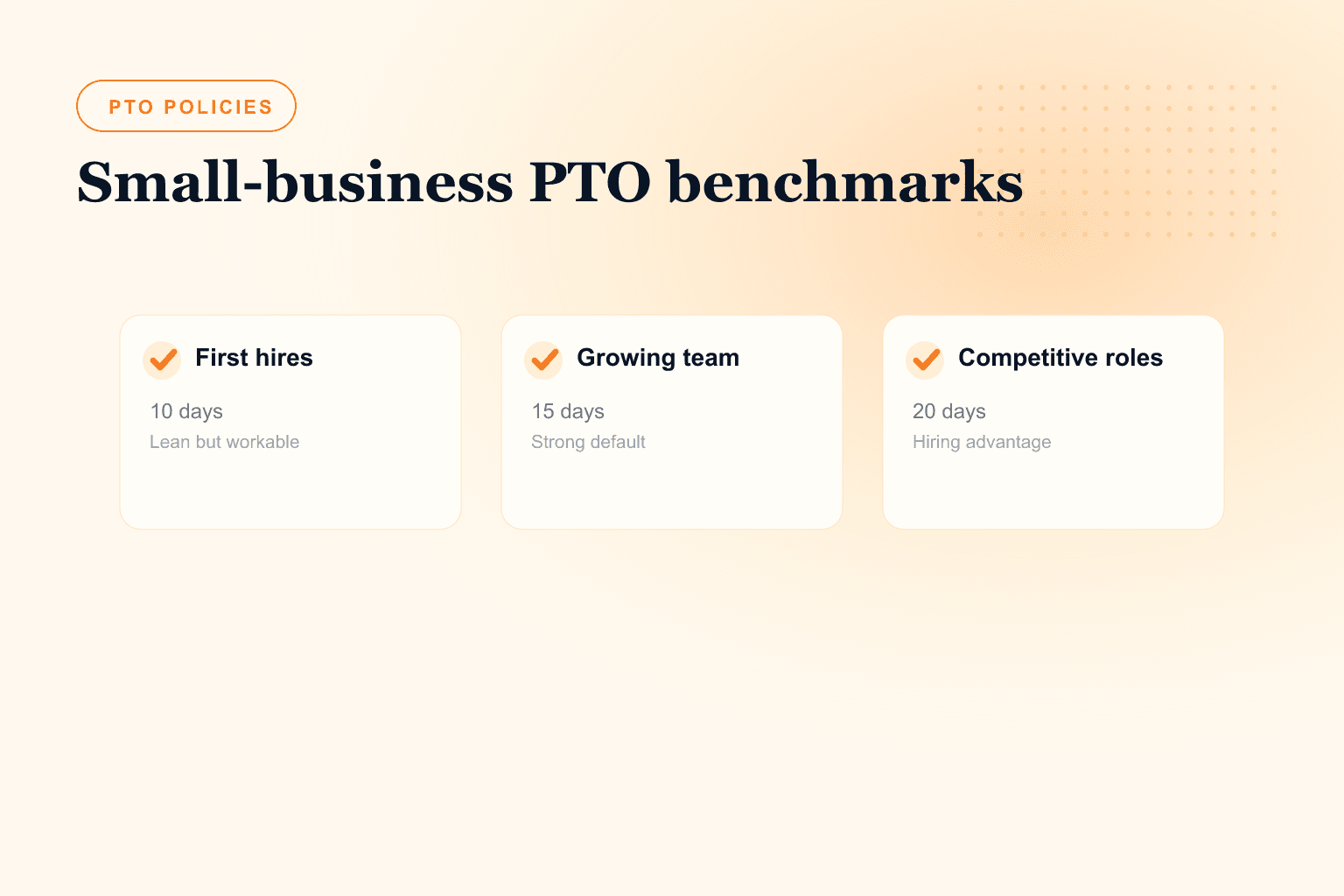
| First hires | 10 days | Works for hourly or early-stage teams, but can feel thin for experienced hires. |
| Growing small business | 15 days | A strong default for most teams under 100 people. |
| Competitive hiring market | 20 days | Better for professional roles, startups, and teams competing with larger employers. |
| Unlimited PTO | No fixed bank | Only works with strong norms and manager follow-through. |
Paid holidays sit on top of this. Many small businesses observe 8 to 10 holidays per year, usually a mix of federal holidays and company-specific closure days.
If you need policy language, start with the free vacation policy template and adapt the allowance table to your team.
Vacation, sick leave, and personal days
Small businesses usually choose one of three models:
Vacation plus separate sick leave. This is the clearest model for most teams. Employees know what is vacation, what is illness, and what laws may apply to sick time.
One combined PTO bank. This is simpler on paper, but harder in practice. If someone uses all their PTO for vacation and gets sick later, managers end up making exceptions.
Unlimited PTO with separate required leave. This can work for salaried teams, but it still needs rules for sick leave, parental leave, bereavement, jury duty, and legally protected leave.
For small businesses without a dedicated HR team, separate vacation and sick leave is usually easier to explain.
What to offer by employee type
Keep the policy simple, but define eligibility clearly.
Full-time employees should have the cleanest standard benefit. Part-time employees can accrue prorated time if your business chooses to offer it or if local rules require it. Contractors generally should not be included in employee PTO policies unless your legal setup says otherwise.
A sample starting point:
| Employee type | Suggested approach |
|---|---|
| Full-time salaried | 15 PTO days plus holidays |
| Full-time hourly | 10 to 15 PTO days, accrued per pay period |
| Part-time | Prorated PTO or sick leave where required |
| Contractors | Excluded from employee PTO policy |
This is operational guidance, not legal advice. Check state and local requirements before publishing a final policy.
Accrual or lump sum?
If you are choosing your first policy, lump sum is simpler. Employees receive their annual bank at the start of the year or on their hire anniversary. Everyone understands it immediately.
Accrual is better when you want tighter liability control. Employees earn time over the year, which can matter if someone leaves shortly after joining. The tradeoff is tracking complexity.
If you use accrual, use a system that calculates balances automatically. Manual accrual math in a spreadsheet is where small errors turn into awkward conversations.
How to make the number feel fair
The PTO number is only one part of the employee experience. The rest is whether people can actually use it.
A 15-day policy feels generous when managers approve requests consistently, leaders take vacation themselves, and employees know their balances. A 20-day policy feels fake if everyone is afraid to be away.
Set the number, write the rules, and make the workflow visible.
How Cabana handles this
Turn your PTO benchmark into a real policy.
Cabana's free policy generator helps you turn your PTO allowance, carryover rules, and request process into a clear small-business policy.
30 days · No credit card
Bottom line
For most small businesses, 15 days of PTO plus holidays is the cleanest starting point. Move down only if coverage is genuinely tight, and move up if you are competing for experienced hires.
Whatever number you choose, do not leave it informal. Put it in writing, connect it to a request process, and review it once a year as your team grows.