The 30-second version
- A good vacation policy is short, clear, and consistently enforced.
- Set a real vacation amount instead of saying "flexible" with no benchmark.
- Define request lead time, approvers, overlap rules, and blackout periods.
- Review carryover and payout language against state requirements.
- Use the vacation policy template when you are ready to draft.
Vacation policy best practices are mostly about avoiding ambiguity.
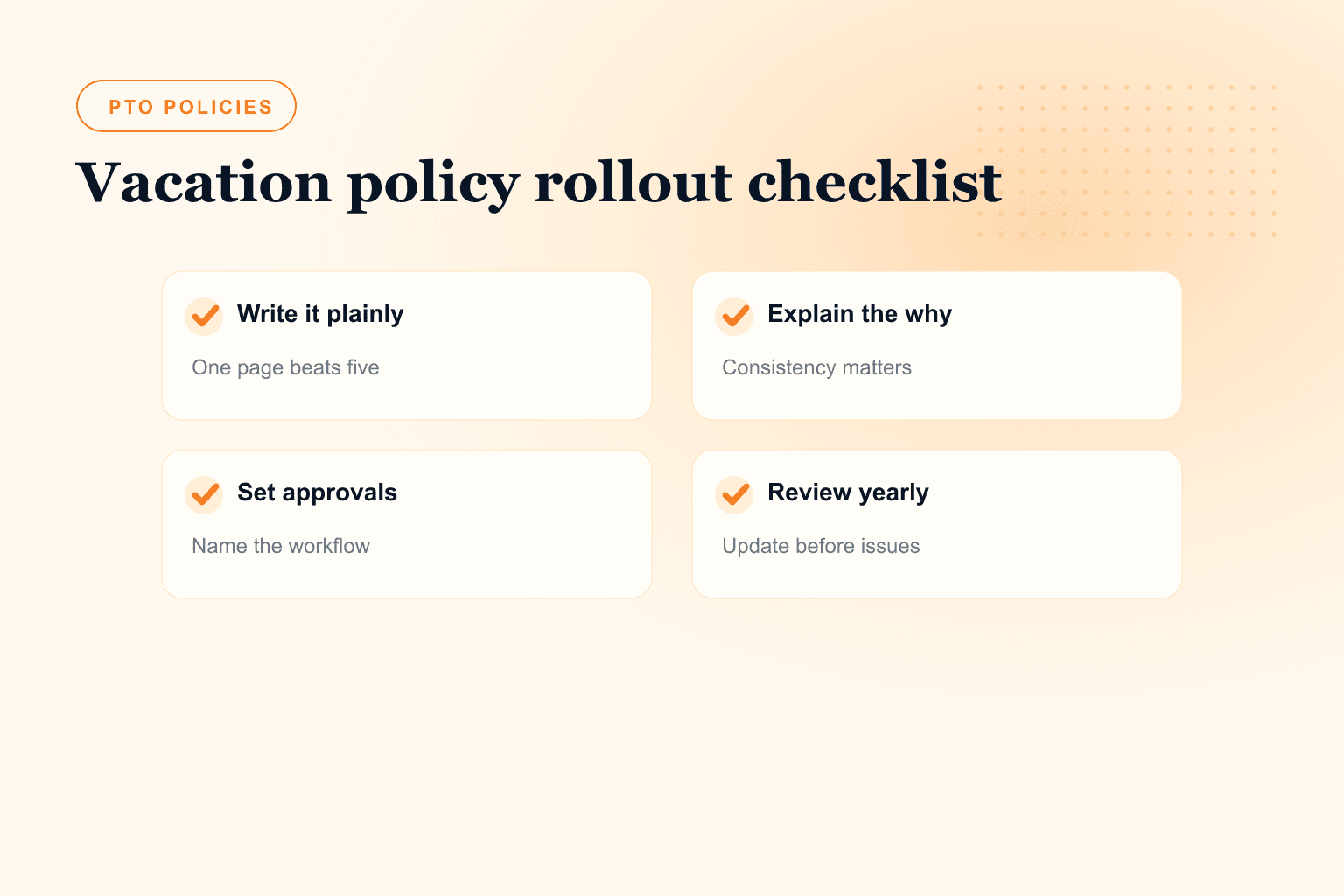
Small teams do not need enterprise HR language. They need a policy that employees can understand, managers can apply, and founders can defend when an edge case shows up.
1. Write the policy before the first conflict
The worst time to invent a vacation rule is when two employees already want the same week off.
Write the policy before the decision is personal. That way the answer comes from the system, not from a manager's mood or relationship with the employee.
2. Use a specific vacation amount
"Flexible vacation" is not a policy unless you define what flexibility means.
For many small teams, 10 to 15 vacation or PTO days is a reasonable starting point. Competitive teams may offer 15 to 20 days. If you use unlimited PTO, define a minimum expectation so employees know they are actually allowed to take time away.
See average PTO for small businesses for benchmarks.
3. Define the request workflow
Every vacation policy should say:
- Where employees submit requests.
- How far in advance they should ask.
- Who approves.
- How approval is confirmed.
- Where approved absences are visible.
This is one of the easiest ways to reduce manager back-and-forth.
4. Plan for overlap
Small teams feel absences quickly. Your policy should explain that approvals depend on coverage and business needs.
You do not need a harsh rule. You just need enough language to handle cases where too many people request the same days.
5. Be careful with carryover
Carryover seems like a simple perk, but it affects liability and administration.
If you allow carryover, set a cap. Many small businesses use 5 to 10 days. If you do not allow carryover, confirm that your state allows forfeiture rules and write the rule clearly.
6. Say what happens when someone leaves
Vacation payout on separation depends on state law and your written policy. Some states require payout of accrued vacation. Others give employers more flexibility if the policy is clear.
Do not leave this silent. Silence creates surprise costs and employee disputes.
7. Make tracking boring
The best policy is the one nobody has to chase.
Employees should be able to see their balance. Managers should see who is out. The person handling HR should not need to reconcile a spreadsheet every month.
If tracking is already painful, your next step is not a more detailed policy. It is a better workflow.
How Cabana handles this
Make vacation requests easy to approve.
Cabana gives small teams a Slack-native vacation workflow with requests, approvals, balances, and shared coverage visibility.
30 days · No credit card
Bottom line
The best vacation policies are plain, specific, and usable. Pick the amount, define the workflow, write the edge-case rules, and review the policy every year.