The 30-second version
- A paid time off policy should explain how employees earn, request, use, and carry over PTO.
- For most small businesses, 10 to 15 days is a reasonable starting range.
- The policy should be short enough for employees to understand and specific enough for managers to enforce.
- State rules can affect sick leave, payout, and use-it-or-lose-it language.
- Use the complete small-business PTO policy guide as the pillar reference.
A paid time off policy turns a fuzzy benefit into a clear operating rule.
That matters more for small businesses than people expect. When you only have a handful of employees, every absence affects coverage. If the rules are informal, managers start making one-off decisions, employees compare outcomes, and the process gets messy fast.
What a PTO policy does
A PTO policy answers four employee questions:
- How much paid time off do I get?
- When can I use it?
- How do I request it?
- What happens if I do not use it?
It also answers the manager version of those questions: who approves requests, how to handle overlap, and what to do when the policy conflicts with a business need.
The core sections to include
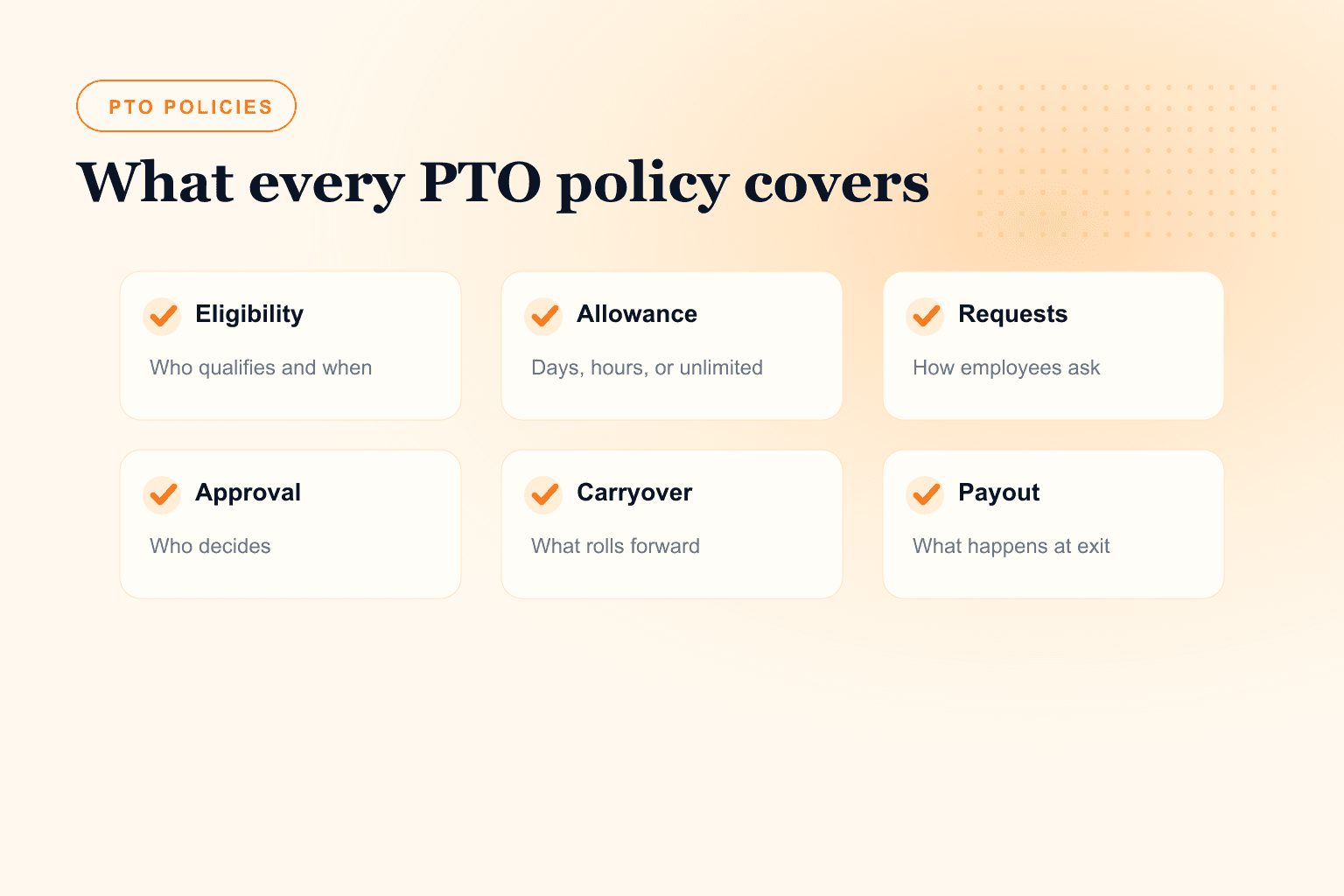
Use this structure for a small-business paid time off policy:
| Section | What it should say |
|---|---|
| Eligibility | Which employees qualify and when the benefit begins. |
| Amount | How many days or hours employees receive. |
| Earning method | Whether PTO is accrued, front-loaded, or unlimited. |
| Requests | How far in advance employees should request time off. |
| Approvals | Who approves, and how conflicts are handled. |
| Carryover | Whether unused PTO rolls over, and any cap. |
| Separation | Whether unused PTO is paid out when employment ends. |
| Other leave | How PTO interacts with sick, parental, bereavement, or protected leave. |
If you want copyable language for these sections, use the sample PTO policy for small businesses.
Choosing the right PTO amount
For most small businesses, 10 to 15 days is the practical range. Ten days is a lean policy. Fifteen days is a stronger default for professional teams. Twenty days is a competitive offer when hiring against larger companies.
Holidays are usually separate. A common setup is 15 PTO days plus 8 to 10 paid holidays.
For more detail, see average PTO for small businesses.
Accrual, annual bank, or unlimited
An annual bank is the simplest: employees get a fixed number of days each year.
Accrual is more controlled: employees earn PTO over time, usually each pay period or month.
Unlimited PTO removes the fixed balance but requires stronger manager norms. Without clear expectations, people can end up taking less time off because they do not know what is acceptable.
If you are unsure, start with an annual bank. It is easier to explain and easier to administer.
Do not skip the request process
The request process is where small-business PTO policies often fail.
"Ask your manager" is fine at three people. At fifteen people, it creates lost approvals, duplicated requests, and coverage surprises.
Define the actual workflow:
- Where requests are submitted.
- How much advance notice is expected.
- Who approves.
- How employees know a request was approved.
- Where approved absences appear for the team.
This is the bridge between policy and operations. A policy that cannot be used day to day is just a document.
How Cabana handles this
Make your PTO policy usable in Slack.
Cabana turns your policy into a request, approval, balance, and team-calendar workflow your employees can use without leaving Slack.
30 days · No credit card
Bottom line
A good paid time off policy is clear, specific, and boring in the best way. Employees know what they get. Managers know what to approve. The business can plan around absences.
Write the policy once, review it annually, and connect it to a tracking process before the first edge case arrives.