The 30-second version
- The three main PTO plans are accrual, annual bank, and unlimited PTO.
- Annual bank is the simplest default for most small businesses.
- Accrual gives more control but requires better tracking.
- Unlimited PTO works only when managers set clear expectations and model time off.
- Once you pick a plan, turn it into a written PTO policy.
Choosing a PTO plan is the first real decision in a small-business time off policy.
The plan determines how employees receive paid time off, how balances are tracked, and how complicated administration becomes. Most small businesses should choose the simplest plan that still handles their risk.
Plan 1: Annual PTO bank
Employees receive a fixed number of PTO days each year, often on January 1 or their work anniversary.
Best for: Small salaried teams that want simple administration.
Example: Full-time employees receive 15 PTO days per year. New hires receive a prorated amount.
Pros: Easy to explain, easy to budget, and friendly to employees who want to plan vacations early.
Cons: If someone uses the full bank early and leaves, your ability to recoup the time may be limited.
For most small businesses, this is the best starting point.
Plan 2: Accrual-based PTO
Employees earn PTO gradually over time, usually each pay period or month.
Best for: Hourly teams, teams with turnover, or businesses that want tighter control over earned balances.
Example: Employees accrue 1.25 PTO days per month, equal to 15 days per year.
Pros: Balances grow with service time and payout calculations can be cleaner.
Cons: Accrual math needs to be tracked accurately. Manual spreadsheets get messy fast.
If you choose accrual, use software or a payroll-connected process. Do not rely on memory.
Plan 3: Unlimited PTO
Employees do not have a fixed PTO bank. They request time off as needed, subject to manager approval and business coverage.
Best for: High-trust salaried teams with clear performance expectations.
Example: Employees may take PTO as needed, with manager approval, provided work and coverage are handled.
Pros: No balance accounting for ordinary vacation and an attractive recruiting message.
Cons: Employees may take less time off without a clear norm. It can also create inconsistent approvals if managers are not aligned.
Unlimited is a culture policy as much as an HR policy.
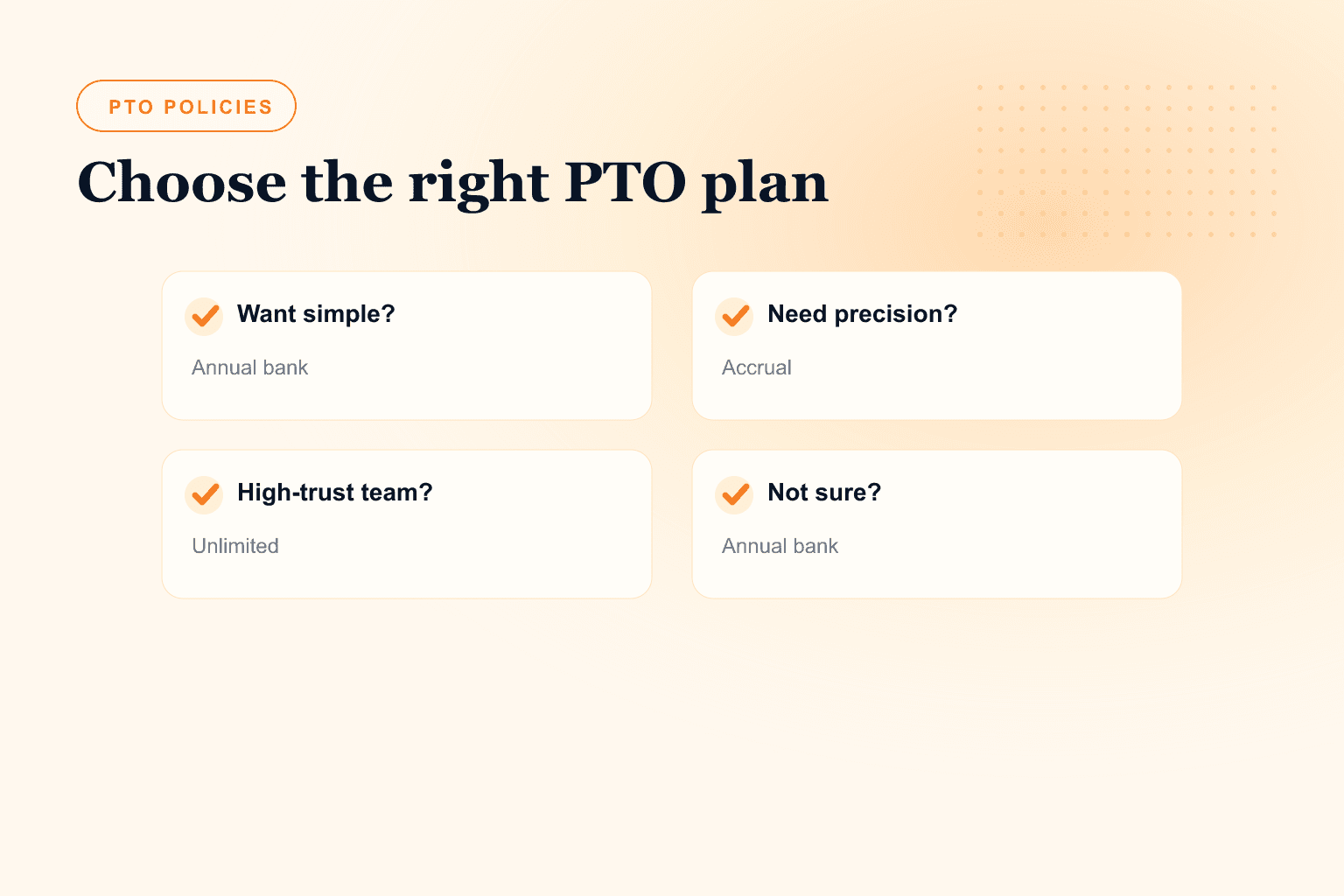
Which PTO plan should you choose?
Use this shortcut:
| If this is true | Choose |
|---|---|
| You want the easiest policy to explain | Annual bank |
| You have hourly employees or turnover concerns | Accrual |
| You have mature managers and output-based roles | Unlimited |
| You are unsure | Annual bank |
Then decide the amount. If you need a benchmark, read average PTO for small businesses.
Tracking requirements by plan
Annual bank needs balance tracking. Accrual needs balance and earning calculations. Unlimited needs request and coverage tracking even without balances.
No plan removes the need for approvals. The plan only changes what needs to be tracked.
How Cabana handles this
Pick the PTO plan. Cabana handles the workflow.
Cabana supports small teams that need simple PTO requests, manager approvals, automatic balances, and visibility into who is out.
30 days · No credit card
Bottom line
If you are writing your first PTO plan, choose an annual bank. It is simple, understandable, and good enough for most teams.
Move to accrual when you need more control. Use unlimited only when your managers are ready to make the norm explicit.